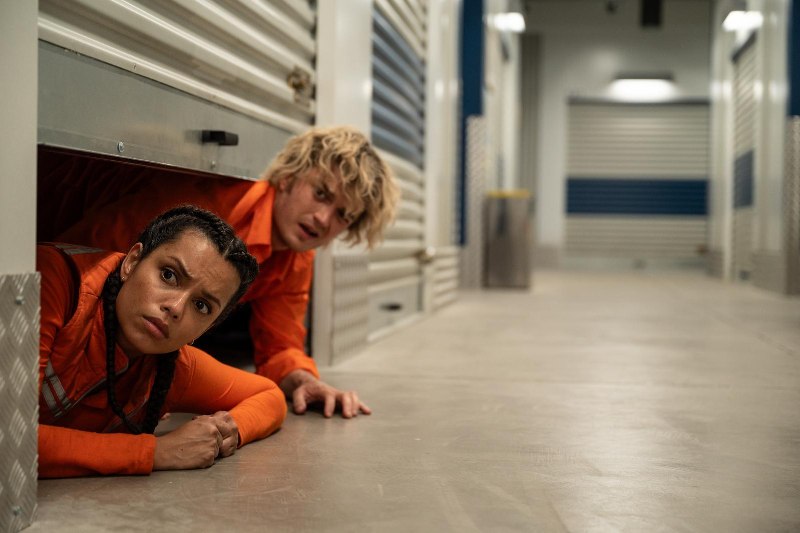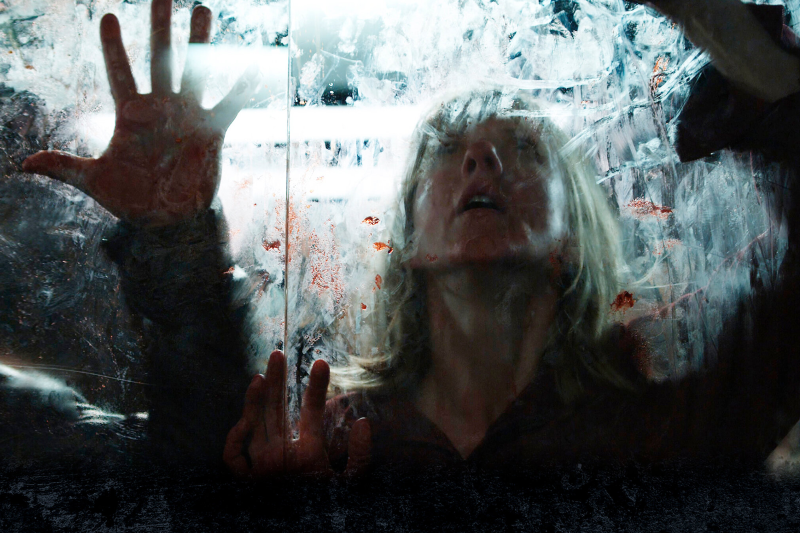



It's the holiday season! That means it’s finally time to explore a Uterus Horror film that feels like it’s one part The Blackcoat’s Daughter and one part Jennifer’s Body, The Sacrifice Game. Written by Sean Redlitz and Jenn Wexler, with Wexler also directing, The Sacrifice Game takes place at a remote all-girls boarding school in 1971. It’s Christmas vacation and everyone has gone home for the holidays – everyone except two students and the two employees tasked with their care. The attempted holiday cheer is shattered when a group of infamous killers arrive at the school’s doorstep to complete a demonic ritual.
The audience is first introduced to Samantha (Madison Baines). Samantha is new to the school, only having attended for one semester. While this information is gleaned through brief conversations, we learn Samantha’s mother died in a car crash, leaving Samantha in the care of her stepfather. While her biological father is never mentioned, it’s clear her stepfather is the only family she has. What also becomes clear is that this man doesn’t know what to do with Samantha now that her mother is gone. He throws her into Blackvale Academy promising that the boarding school is just a trial run and that she will be brought home for the holidays. Yet, at the last minute, the stepfather calls to tell Samantha plans have changed and she will be staying put.
The Sacrifice Game also introduces Clara (Georgia Acken). At first, little is known about Clara. She’s clearly a loner, doesn’t seem to have any friends at school, and generally keeps to herself. She’s also staying at the school for the holidays, although that seems to have always been the plan. Clara is a mystery. It isn’t until the school is invaded that the truth about this teenage girl comes to light.
A group known in the news as “The Christmas Killers” has been ritualistically killing people and leaving demonic symbols across the state. Their final destination is Blackvale Academy. Once they arrive, the audience learns Maisie (Olivia Scott Welch), the leader of the Christmas Killers, was a former student at the school. While there, she discovered a dark book of magic in the basement and was promptly kicked out of school for dabbling in demonic practices – but not before she ripped an important page from the book. Since then, her goal has been to complete the ritual that will summon a demon to grant Maisie and her friends their deepest desires. After killing people, and following the page’s instructions, Maisie and her friends arrive at the school to complete the ritual by spilling the blood of the innocent. They kill the girls’ teacher t, Miss Rose Tanner (Chloë Levine), but the demon doesn’t come. Maisie goes in search of the book, which leads to a shocking discovery. The ritual doesn’t summon a demon, and there’s still one final step before it’s complete.
While Maisie and some of the others are distracted, Clara takes charge and ensures Samantha can escape to get help. What Samantha doesn’t realize is that Clara is the demon. Hundreds of years ago, a group of men performed a ritual to summon Clara, but panicked at the last minute and created a fire that destroyed the town where Blackvale sat. Clara has been trapped ever since, cursed to be a teenage girl at the school until someone performs the ritual that will unbind her. That’s the real ritual Maisie has been mistakenly performing by killing innocent people. The last step is to spill the blood of the guilty, which means Maisie and her murderous buddies. Clara isn’t allowed to do the killing herself, so she either makes the group kill each other or themselves until Maisie is the only one left. That’s when Samantha returns, after finding a phone to call for help, because she couldn’t leave Clara behind.
Watching The Sacrifice Game, the juxtaposition between the very different characters of Samantha and Clara only help to strengthen those things that make them similar. At a glance, Samantha is a sweet, innocent teenage girl longing for the familial connection she lost. Clara, on the other hand, is an ancient demon with immense power and a love of carnage. Even before Clara is revealed as the demon, their differences are still quite obvious just in their demeanor. Yet they do share a number of similarities. They are loners, wanting to be on their own and not letting people in easily. They both also desperately want to get away from Blackvale Academy. For Samantha, it’s an unfamiliar place she’s been forced into because the family she had no longer exists. Meanwhile, Clara has been bound to this school since before it was built. She can’t grow up and can’t leave the property to travel the world. Neither girl has another person they can trust and rely on, until now.
At first, when Samantha learns who Clara really is, she is horrified by the death before her. Clara is angry Samantha came back and interrupted the ritual. After decades of seeing the same kinds of girls come and go at the school, never having a friend, Clara doesn’t understand Samantha. It’s clear Clara cares for Samantha, which is why she let her escape before the killers could harm her, but Clara never expected someone could care for her in return. Samantha came back because Clara is her friend, and she couldn’t let anything bad happen to her. Once she learns Clara is a demon and Clara makes it clear the only way for her to be free is if Maisie dies, Samantha does what I wish many other Uterus Horror characters had done – she plants an axe in Maisie. Both girls accept the other for who they are. Now free from Blackvale Academy, Clara and Samantha leave to explore the world open to them, hand in hand.
The Sacrifice Game shows two very different girls at different stages of self-discovery. They both fit into the archetypes of Uterus Horror characters, both being outcasts with a darkness around them and an inability to find meaningful connections with others. While Clara might be an ancient demon, physically both girls are at a formative age, trying to figure out who they are and find their place in the world. Both feel forgotten and abandoned, so it’s only natural they would gravitate to each other. Despite their flaws, Clara and Samantha have found a person who will love them unconditionally. They are now part of a bizarre little found family, both willing to do anything for the other.
Much like Ginger Snaps or Jennifer’s Body, The Sacrifice Game is a Uterus Horror film depicting two very different teenage girls on diverging paths, one toward “evil” and one toward “good.” Yet The Sacrifice Game takes a different approach to this idea. Oftentimes the “evil” character is only acting out their nature because of what was done to them. This is true for Clara as well. She didn’t ask to be summoned, men did that. She also didn’t ask to be trapped as a teenage girl in a school for centuries – once again, men did that.
These characters are not doing the things they do for nefarious reasons, they’re simply doing what they need to in order to survive a hostile world. Samantha, an objectively “good” person, accepts Clara for who she really is. The way these two characters come together, forming a close bond in the most unlikely of circumstances, is beautiful to watch. It tells a compelling Uterus Horror story, but with a far more satisfying ending than fans typically see in this subgenre. Samantha and Clara not only learned about each other, but they learned about themselves too. They now understand they don’t want to be alone, despite pushing others away up to this point, and more importantly they are willing to do anything for the people they love. Together, Clara and Samantha are unstoppable, and watching them walk off together rather than killing one another is sure to have many cheering for joy.
About this series: in a genre typically considered “for the guys,” it’s time to give a nod to the ladies. Uterus Horror is a subgenre of horror films that focuses on the uniquely female experience of puberty and the act of coming into your sexuality, using horror elements to emphasize and/or act as a metaphor for that experience. These films are often ignored in theaters but quickly develop cult followings. Columnist Molly Henery, who named and defined the subgenre, tackles a new film each month and analyzes how it fits into this bloody new corner of horror.